

🤖 Best Robotics Classes for Kids in Delhi: What Should Parents Actually Look For?
Your 9-year-old has spent the last week asking how the toy car moves. Then comes the inevitable question: "Can I build a robot?"
You search for robotics classes for kids in Delhi. Within minutes, you find weekend classes, summer camps, coding academies, STEM workshops, DIY kits and programmes that all promise to make your child "future-ready."
They may all look similar on a screen. They aren't.
A robotics class can start with a mentor showing children how a robot works, with students building alongside them step by step. But the more important question is what happens once the robot is ready. Does the child understand why each component is there? Can they explain what the sensor is doing? Can they change the code and predict what will happen? Can they modify the robot when the original design doesn't solve the problem?
Because that curiosity — the "what if I change this?" moment — is where robotics becomes much more than building a machine.
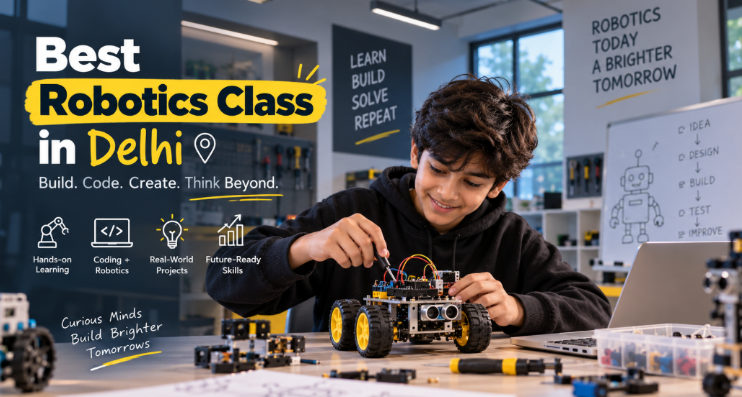
A child who starts by wondering how a toy car moves can eventually begin asking how a sensor detects an object, why a motor behaves differently at different speeds, what happens when a line-following robot loses its path, or whether they can redesign it to work better.
And once a child learns to approach one problem that way, they can carry the same curiosity into almost anything.
📑 Table of Contents
Is project-based robotics better than simply learning robotics theory?
What if your child's robotics journey could begin with an IIT Delhi connection?
Debugging Turns a Robot Project Into a Problem-Solving Exercise
What makes Rancho Labs a relevant option for parents looking for robotics classes in Delhi?
Rancho Labs gives parents concrete ways to evaluate the learning experience
🎯 What Makes a Robotics Class Genuinely Useful for Kids?
So, if you are looking for the best robotics classes for kids in Delhi, the question shouldn't just be "Which class will teach my child robotics?"
A better question is:
"What will my child be able to do with what they learn?"
And that is where the differences between robotics programmes start becoming much easier to see.
In the first class: the child followed a worksheet. The ultrasonic sensor was connected in a particular way because the instructor said so. The code was already available. When the robot stopped working, the instructor fixed it.
In the second class: the child knows that the sensor measures distance. They know that the motor needs instructions. They can identify which part of the code tells the robot what to do when an obstacle is detected. When the robot turns too late, they can investigate the problem.
🔎 The physical robot may look identical. The learning isn't.
That is why the first thing to examine when comparing robotics classes for kids in Delhi is not the kit. It is the curriculum behind the kit.
🧰 The Curriculum Behind the Kit Matters More Than the Kit
A strong robotics curriculum should progressively introduce mechanics, electronics, sensors, programming and problem-solving through projects. Younger children may begin with movement, simple circuits and visual coding, while older learners can progress into microcontrollers, sensors, 3D design and increasingly independent robotics projects.
💡 The important part is progression, not the number of components in the kit.
A parent does not need to become an electronics engineer before choosing a robotics course. You simply need to look for evidence that the curriculum moves beyond assembling things.
🧠 A Robot Is a System
A child first needs to understand that a robot is a system:
⚡ Something provides power
🔧 Something makes it move
👀 Something tells it what is happening around it
🧩 Something processes information
🎮 Something tells the motors what to do
This is where motors, circuits, sensors and control systems begin to make sense.
Instead of introducing each component as an isolated piece of theory, a project can give the child a reason to understand it.
🛣️ A line-following robot, for example, gives sensors a purpose.
🚧 An obstacle-avoiding robot gives distance sensing a purpose.
💡 An automated light gives a light sensor a purpose.
The child is no longer memorising what an IR sensor does. They need it because their robot cannot complete the task without it.
💻 Then Comes Code
Coding becomes much easier to understand when the output is visible. A child changes something in the programme. The robot behaves differently.
That immediate relationship between instruction and outcome makes concepts such as sequencing, conditions and loops less abstract.
For younger learners, this can begin with visual or block-based coding. As children progress, they can move towards text-based programming and hardware control.
❓ The important question is not whether a programme uses a particular programming language. It is: Does the child understand why they are writing the code?
At What Age Should a Child Start Robotics?
There is no magical age at which a child suddenly becomes "ready" for robotics. A seven-year-old and a fourteen-year-old can both learn it. They simply shouldn't be learning it in exactly the same way.
Younger students can begin with construction, movement, visual programming and simple sensors.
At this stage, success might mean understanding that changing an instruction changes how a robot behaves. As students grow, they can move towards electronics, Arduino-based projects, 3D design, automation and more independent programming. An older student might combine several sensors, write the control logic and debug the system independently.
That progression is what makes an age-appropriate robotics programme important. A programme designed for teenagers can overwhelm a younger child with terminology and hardware before they have developed the underlying concepts. At the other extreme, a teenager who has already built several projects may stop learning if every session begins with the same introductory activity.
📈 The Projects Should Evolve With the Child Too
A beginner might build a simple sensor-based robot and learn how movement changes in response to an input. With more experience, the same student could work on:
🚧 An obstacle-avoiding system
🕹️ An interactive device
🏠 An automated model
🛠️ A custom-designed mechanism
The important part is that the child is applying a new concept rather than simply reproducing a finished model.
This is why a programme's project list can tell you more than a broad age range such as "for children aged 6–16." Rancho Labs' published robotics material, for example, describes projects involving line-following and obstacle-avoiding robots, sensor integration, interactive lighting, smart devices and 3D-designed models, while introducing students to motors, sensors, microcontrollers and programming.
🐛 A Good Project Should Create a Problem for the Child to Solve
The robot doesn't detect the object. The wheels move in the wrong direction. It overshoots the line. The motor doesn't respond.
Now the child has a reason to debug.
They have to ask, "What went wrong?"
That question is often where robotics starts becoming engineering rather than simply craft. The goal is not just for a child to build a robot that works. It is for them to understand why it works, figure out why it sometimes doesn't, and gradually become confident enough to fix it themselves.
So when comparing robotics programmes, look beyond the minimum age. Ask:
Are students grouped by age or skill level?
How does the difficulty increase?
What does a beginner build? What does an advanced student build?
Do projects require children to solve problems independently?
Is Project-Based Robotics Better Than Simply Learning Robotics Theory?
Project-based robotics gives children an opportunity to apply concepts immediately instead of keeping theory and practice separate. When a child needs a sensor to solve a project problem, the concept has a purpose. They can test it, observe the result, identify errors and modify their solution. That creates a more direct connection between learning and making.
This is also why you should be careful with the phrase "hands-on learning."
⚠️ Almost anything can be called hands-on.
A child can physically assemble a kit without understanding what they are doing.
🔑 The better question is: What does the child's hand actually have to figure out?
Rancho Labs describes its year-long programmes around a Learn → Build → Innovate framework: concepts are introduced in the context of a project, applied to a physical build and then extended into more open-ended challenges.
That progression is important:
📖 Learn: The child understands how a sensor works.
🔨 Build: The child uses that sensor in a robot.
🚀 Innovate: The child changes the robot to solve a slightly different problem.
The third stage is where the learning becomes more independent.
✅ Compare Programmes by Learning Depth and What It Provides to Your Child
Compare robotics classes on curriculum depth, project progression, mentor interaction, age suitability, learning format and what students actually build. Fees and location matter, but they should come after understanding what your child will learn. A cheaper programme is not better value if the child spends most sessions following instructions without developing independent skills.
What to compare:
What to Compare | Key Question |
📚 Curriculum | What concepts are taught, and in what order? |
🛠️ Projects | What will my child actually build? |
🎂 Age level | Is the programme designed for my child's grade and experience? |
💻 Coding | Will my child write or understand code, or only use pre-built blocks? |
⚙️ Hardware | Will children work with real sensors, motors and circuits? |
🧑🏫 Mentoring | Can the instructor see and troubleshoot my child's work? |
📈 Progression | Does the difficulty increase over time? |
🧭 Independence | Are children eventually asked to modify or design solutions themselves? |
🖥️ Format | Is it live online, offline or pre-recorded? |
🏆 Outcome | What does the child have to demonstrate at the end? |
Notice what is missing from the top of the list: the size of the robot.
A large robot is not automatically a better learning experience. A sophisticated-looking kit can still hide a very simple curriculum.
🎓 What If Your Child's Robotics Journey Could Begin With an IIT Delhi Connection?
What if your child's robotics journey could begin with the influence of one of India's leading engineering institutions — IIT Delhi? For a child who is already curious about how machines work, that connection can add another layer to the learning experience: an opportunity to explore robotics through a programme shaped by people who have studied and worked in that environment.
Rancho Labs was founded by IIT Delhi alumni and professors in 2019, and the organisation states that it is incubated and supported by the Technology Innovation Hub of IIT Delhi, IHFC. Its co-founders, Anshul Agrawal and Aman Kumar, are IIT Delhi BTech alumni.
That connection is not meant to replace the actual classroom experience. What matters is how that institutional association translates into what a child gets to learn, build and explore.
At Rancho Labs, the published programme material describes live instruction and project-based learning across robotics, sensors, electronics, coding and 3D design. Its school programme information also includes Robotics, Coding & AI workshops covering theory, logic, programming, circuitry and hands-on robotics projects.
For a parent, the interesting part is what that foundation can bring into the learning journey. Your child can be introduced to robotics through mentors who guide them through the build, while the curriculum gives them opportunities to understand the systems behind what they are making and gradually work with more complex projects.
🔍 So when you come across an IIT Delhi or IHFC connection while comparing robotics classes, look beyond the name and into the learning experience behind it: who designed the programme, who teaches it, what students build, and how their skills progress from one project to the next.
🖥️ Choose the Format That Helps Your Child Keep Building
Choose the format that gives your child the stronger learning experience and fits your family's routine. Offline classes can make physical collaboration easier, while live online classes can remove travel and location constraints. What matters is whether the child receives live guidance, works on real projects and gets enough interaction to solve problems rather than simply watch demonstrations.
📍 For a Delhi parent, this can be surprisingly practical.
A class that is 45 minutes away may sound manageable on paper. Add school, homework, traffic, dinner and exams. Now a weekly robotics class becomes another logistical problem.
At the same time, some children learn better when they are physically surrounded by other builders and can work alongside their peers.
❌ So don't ask: "Is online or offline better?" ✅ Ask: "Which format will allow my child to consistently build?"
Rancho Labs currently describes both online and offline learning options for its programmes, with live sessions rather than only recorded material.
The format should serve the learning. Not the other way around.
Look for projects that require the child to apply concepts, test a result and make changes — not simply assemble a predetermined model. Ask to see examples of completed student work. A genuinely project-based programme can explain what students build, what concepts each project teaches and how the projects become more challenging as the child progresses.

🧪 Here Is a Simple Test
Ask the centre:
"What will my child build in the first few sessions?"
"What happens after they can already build it?"
That second question is often more revealing.
A strong curriculum has somewhere to go:
The project changes. The child's role changes too.
At first, they are learning how the system works. Eventually, they are deciding how the system should work.
That is the progression parents should look for.
🛤️ Look for a Project Pathway, Not Just a One-Off Build
A robotics programme should not end with a child assembling a robot and watching it move. The projects should become more challenging as the child's understanding grows, with each build introducing a new concept or giving them more independence.
Before enrolling, look beyond the number of projects listed in the curriculum. Look at how those projects connect. A beginner might start by understanding motors and simple sensors, then move towards programming movement, combining multiple inputs, designing mechanisms or building systems that respond to changing conditions. The child should gradually move from following instructions to making decisions about how their project works.
👨🏫 The role of the instructor matters too. A good class does not require the instructor to solve every problem for the child. Instead, the instructor provides enough guidance for the child to understand what went wrong and try again. This is particularly important when a project fails.
🐛 Debugging Turns a Robot Project Into a Problem-Solving Exercise
Robotics gives children a physical system that responds to their decisions, making problem-solving visible. When a robot fails to follow a line or detect an obstacle, the child has to inspect the system, identify a possible cause, test a change and observe the result. Debugging becomes part of the learning rather than a mistake to hide.
That process is worth more than getting the robot right on the first attempt.
Consider a child who builds a line-following robot.
It keeps drifting away from the line.
There could be several reasons:
📍 The sensor might be positioned incorrectly.
⚙️ The threshold in the code might need changing.
🔋 The motors might not be behaving equally.
🌗 The sensor could be reading the surface differently from what the child expected.
The child now has a real problem to solve.
They make a change. Test again. It fails. They change something else. Test again.
Eventually, the robot follows the line.
The important outcome is not only the moving robot. It is that the child has experienced a process for approaching an unfamiliar problem: observe, identify, test, adjust and try again.
That is why a project pathway matters. The best programmes do not simply give children more complicated robots to build. They gradually give them more complicated problems to solve.
When evaluating a programme, look for evidence of that progression. The curriculum should show how projects change across age or skill levels, how coding develops alongside hardware, how much of the work students complete independently and what they are expected to demonstrate by the end. Examples of previous student projects can also reveal whether children are creating and problem-solving or simply reproducing a model shown by the instructor.
If the programme can clearly show what a beginner builds, how that student progresses and what they can eventually create independently, you have something concrete to evaluate.
If the description only promises that classes are "fun, engaging, innovative and future-ready," look for the projects behind those words.
🏆 A Hands-On Approach to Learning Robotics at Rancho Labs
Rancho Labs is a relevant option for parents looking for robotics classes in Delhi because it brings robotics, coding, and hands-on physical projects together within a programme framework designed by IIT Delhi alumni and supported by IHFC, the Innovation Hub of IIT Delhi.
Its robotics programmes expose students to sensors, motors, circuits, programming, 3D design, and real-world project applications, allowing them to experience how different technologies work together rather than learning them in isolation.
What makes this approach particularly meaningful is the emphasis on building and applying. Rancho Labs connects robotics with coding, electronics, design, and problem-solving through its Learn → Build → Innovate framework, placing projects at the centre of the learning journey. For parents, this shifts the focus from simply asking whether their child will learn robotics to something far more valuable:
🎯 What will my child actually be able to build with what they learn?
✅ Rancho Labs Gives Parents Concrete Ways to Evaluate the Learning Experience
If you are looking for a programme where robotics is taught through coding, electronics and physical projects, Rancho Labs is worth evaluating alongside other options. Its IIT Delhi alumni foundation, IHFC backing, project-based framework and published robotics curriculum give parents concrete criteria to examine rather than asking them to choose on branding alone.
And that distinction is important.
The goal of this guide is not to suggest that one logo automatically makes a robotics class better.
It is to give you a way to judge the class before you pay for it.
If you visit a Rancho Labs programme, look at the same things you should look for anywhere:
🛠️ What is the child building?
📚 What are they learning through it?
❌ What happens when it doesn't work?
📈 How does the next project become harder?
🙋 How much of the solution belongs to the child?
Rancho Labs' published robotics material includes projects such as obstacle-avoiding robots, sensor-based systems, interactive devices and 3D-designed models, while its programmes are presented for school students across different grade levels.
Those are the details that make a programme possible to evaluate.
🏙️ What Are the Best Robotics Classes for Kids in Delhi?
The best robotics classes for kids in Delhi are not necessarily the ones with the biggest kits, loudest promises or most impressive-looking projects. They are the programmes where children learn concepts, apply them to real builds, debug what fails and gradually take more ownership of the solution. For parents, curriculum depth and project progression are better indicators than marketing language.
Your child does not need to leave the first class knowing how to build a sophisticated autonomous robot.
They need to leave knowing something they did not know before.
⚙️ Maybe it is why a motor turns.
👁️ Maybe it is how a sensor detects an obstacle.
🔁 Maybe it is how a loop changes a robot's behaviour.
🤔 Maybe it is why their first design failed.
Then the next project should make them use that knowledge. And the one after that should make them question it.
That is how a robotics programme becomes more than an after-school activity.
It becomes a place where a child moves from:
"How does this work?" 🧐 to "Let me try." 🙌 and eventually: "I have an idea. What if I change this?" 💡
That is the progression worth looking for when you compare robotics classes for kids in Delhi.
🔬 Projects Turn Robotics Into Experiential Learning
The real value of project-based robotics is that children don't just learn a concept — they experience what that concept can do. Building a working model gives them a chance to experiment, make decisions, observe what happens and improve their approach when something doesn't work as expected. A sensor, circuit or piece of code that may seem abstract in a lesson suddenly has a purpose when it becomes part of something the student is trying to create.
This kind of experiential learning through STEM projects can also extend beyond robotics into science, engineering and technology, where students explore ideas by building and testing them themselves. Especially, working on more challenging science projects for Classes 9 to 12 can provide opportunities to connect classroom concepts with practical experimentation, problem-solving and real-world applications.
🎬 Conclusion: Choose the Learning Journey, Not Just the Robot
Your child may start robotics because they want to know how a toy car moves. They may be excited by the idea of building a robot, making lights respond to their commands or watching something they assembled move for the first time.
That excitement is a good place to start. But the value of a robotics programme goes much further than the first working build.
As you compare robotics classes for kids in Delhi, look beyond the kit, the photographs and the promise of "future-ready skills." Look at what happens between the first project and the tenth.
🧠 Does your child understand the concepts behind what they are building?
💻 Do they get opportunities to write or modify code?
🧪 Are they encouraged to test their own ideas?
🛠️ When something fails, does the instructor immediately fix it, or does your child get the chance to figure out why?
Those moments are where the real learning happens.
A strong robotics programme should grow with the child. The projects should become more challenging. The problems should become less predictable. The instructor's role should gradually shift from showing the child what to do to helping them decide what to do next.
At first, your child might need help understanding why a motor turns. Later, they might be able to use that motor to build a line-following robot. Eventually, they may look at the same robot, notice that it keeps losing the line and decide to change the sensor position, adjust the code or redesign part of the mechanism themselves.
The robot has become more complicated, but something else has changed too.
The child has become more independent.
That is ultimately what parents should look for when choosing among robotics classes in Delhi. Not simply what the child can build at the end of a class, but how they learn to think while building it.
Because the goal isn't for your child to become a robotics expert after a few sessions.
It is to give them the confidence to look at something they don't understand and think:
🌟 "I don't know how this works yet. But I can figure it out."
And that is a skill they can take far beyond robotics.
If your child is already curious about robots, coding, sensors or simply enjoys taking things apart to understand how they work, a trial class can be a useful next step. Let them experience the difference between being shown how technology works and being given the opportunity to build, test, break, fix and create with it.
FAQs
🕐 What age can children start robotics classes?
Many programmes introduce robotics in age-appropriate ways from the primary-school years onward. The right starting point depends on the child's age, prior exposure and the level of the curriculum.
📘 What do kids learn in robotics classes?
Children can learn concepts such as mechanics, circuits, sensors, motors, programming and problem-solving by applying them to physical projects.
🌱 Are robotics classes useful for beginners?
Yes. A well-structured beginner programme should introduce concepts step by step and let children build confidence through guided projects before moving towards more open-ended challenges.
🖥️ Should I choose online or offline robotics classes?
Choose the format that gives your child live guidance, meaningful interaction and regular opportunities to build and troubleshoot. Offline classes can make physical collaboration easier, while live online classes can be more convenient.
🔍 How do I know if a robotics class is genuinely project-based?
Ask what your child will build, what concepts each project teaches, how projects become harder and what happens when a project does not work. Specific answers are a good sign that the programme has a defined learning pathway.
🚀 Ready to see what your child could build? Explore Rancho Labs' robotics programme and book a trial class. Know More


Comments