

Activities for Kids After Exams: Meaningful Ways to Rest, Explore and Create
The morning after term exams end, a quiet stillness settles over the household. For weeks, your child's cognitive bandwidth has been fully consumed processing complex formulas, managing strict time limits, and operating under sustained mental pressure. Yet, when the final paper is submitted, families often face an unexpected vacuum: the abrupt transition from intense academic structure to aimless downtime.
Most post-exam routines immediately default to passive screen consumption or complete inactivity. While rest is essential, neuroscientific research in cognitive recovery shows that passive scrolling often leaves children feeling sluggish rather than restored. True cognitive recovery requires a deliberate shift from directed mental effort to unstructured, hands-on creation, making the post-exam pause the perfect time for activities for kids after exams, where children stop consuming technology and start building it.

Table of Contents
The Neuro-Science of Recovery: Why Passive Screens Fail Your Child
How Do You Help Your Child Transition from Screens to Hands-On Activities
Step 1: Igniting Curiosity: How to Spark Interest Without Forcing Study
Step 2: Hands-On Exploration: Hardware Teardowns & Discovery
The Post-Exam Blueprint: Understanding Your Child's Recovery Rhythm
Introduction: The Post-Exam Pause
When the final examination period concludes, parents face a familiar dilemma. The sustained pressure of academic preparation drops instantly, leaving a void that is rapidly filled by mobile screens, television, or total inactivity. While the immediate priority is rest, prolonged passive consumption fails to restore a child's mental sharpness.
Cognitive recovery is not about shutting down the brain; it is about changing the nature of its engagement. When children transition from responding to forced test questions to exploring physical materials and logic, their focus naturally shifts from evaluation anxiety to creative problem-solving.
This guide outlines a clear, step-by-step approach to post-exam activities. By balancing physical decompression with open-ended hardware and software projects, parents can help their children recharge effectively while developing practical engineering skills.
The Neuro-Science of Recovery: Why Passive Screens Fail Your Child
When children complete an intense testing cycle, their nervous systems require deliberate recovery. Cortisol levels remain elevated, and executive function pathways experience significant fatigue.
Neuroscientific research indicates that targeted motor-skill engagement, such as handling physical tools, wiring circuits, or building structural models, activates the brain's default mode network far more effectively than passive screen watching. This state of active rest allows the prefrontal cortex to recover from cognitive fatigue while consolidating problem-solving logic.

Figure 1: How active, hands-on rest compares with passive screen time across the key recovery mechanisms. Conceptual illustration, not measured data.
Key Neurological Mechanisms at Play
Default Mode Network (DMN) Activation vs. Suppression: The brain's Default Mode Network is responsible for memory consolidation, self-reflection, and creative problem-solving. Tactile activities (like manipulating hardware or wiring circuits) allow the DMN to activate smoothly. Conversely, rapid-fire digital screens suppress the DMN, leaving the brain in a state of continuous, passive stimulation that prevents genuine mental reset.
Dopamine Regulation & Sensory Fatigue: Passive screen consumption triggers rapid, short-burst dopamine releases without requiring physical or cognitive effort. This keeps the reward pathway overstimulated while doing nothing to repair prefrontal cortex fatigue. Hands-on creation provides sustained dopamine releases tied to tangible accomplishments, lowering overall anxiety and restoring focus.

Figure 2: Short-burst rewards from scrolling versus the sustained, accomplishment-linked reward of building. Conceptual illustration.
Proprioceptive & Tactile Feedback: Engaging fine motor skills, such as turning a precision screwdriver or placing micro-components, activates the somatosensory cortex. This physical grounding acts as a therapeutic anchor, shifting the child's brain out of the high-stress, evaluation-driven state created by weeks of exam preparation.
The Takeaway: True recovery from academic pressure occurs when children shift from proving what they remember to exploring what they can construct.
How Do You Help Your Child Transition from Screens to Hands-On Activities
Moving a child away from passive screens requires offering a physical experience that matches the immediate feedback and stimulation of a digital interface, without causing cognitive overload. Rather than abruptly imposing bans or strict time limits, guide your child through a natural two-part transition.
Step 1: Igniting Curiosity: How to Spark Interest Without Forcing Study
Immediately after exams, forcing children into another rigid routine triggers natural resistance. Before introducing any technical builds, ignite their innate curiosity through open-ended, low-pressure experiences:
The 48-Hour Decompression: Allow the first two days after exams purely for physical rest, sleep recalibration, and 30–45 minutes of daily morning sunlight exposure without digital screens.
Low-Stakes Tactile Access: Place physical assembly tools, basic mechanical parts, or modeling materials in common living areas without setting deadlines or mandatory goals.
Questioning Everyday Mechanics: Prompt curiosity around household items by asking how things operate (e.g., "How does a TV remote transmit signals without physical wires?") rather than testing textbook facts.
Step 2: Hands-On Exploration: Hardware Teardowns & Discovery
Once curiosity wakes up, children transition naturally from resting to wanting to know how things function on the inside. Provide safe, tactile avenues for discovery:
Hardware Teardown Challenge: Supply an unpowered, obsolete electronic device, such as a computer mouse, a mechanical clock, or an old keyboard, alongside precision screwdrivers. Challenge your child to deconstruct the chassis and trace its internal components.
Micro-Exploration Trips: Visit local maker spaces, interactive exhibits, or automated fabrication facilities to connect textbook theory to physical execution.
Safety Protocols: Always supervise teardowns to ensure no sharp internal edges, charged capacitors, or battery units are present.
By taking systems apart, children gain the baseline confidence required to start constructing their own functional builds.
The Post-Exam Blueprint: Understanding Your Child's Recovery Rhythm
Parenting after exams is not about handing your child a new schedule or enforcing another timetable; they have just survived weeks of rigid schedules. Instead, it is about observing their psychological and physiological energy patterns so you can gently nudge them from passive recovery into active, self-driven creation.
When exams end, a child's energy naturally follows an upward recovery curve. Rather than treating this period like a regimented camp, parents can read their child's cues and match the environment to where they are on that curve.
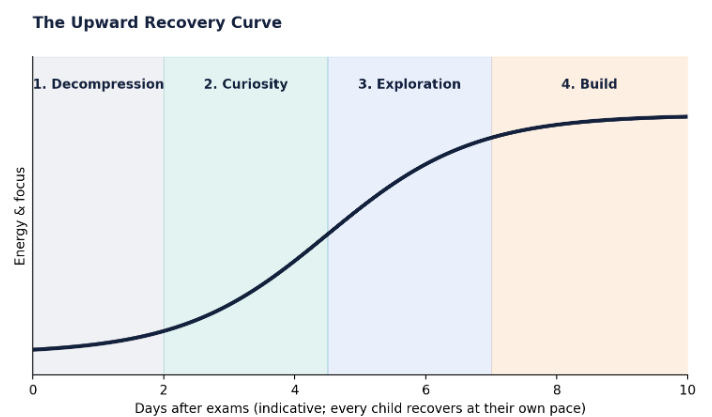
Figure 3: The four natural stages of post-exam recovery along an upward energy curve. Timing is indicative; every child moves at their own pace.
Reading Your Child's Post-Exam Behavior (The 4 Natural Stages)
Instead of forcing activities on fixed days, observe how your child acts and adjust your support accordingly:
1. The Decompression Stage (Behavior: Exhaustion, Moodiness, Need for Sleep)
What You See: Your child sleeps in, moves slowly, and shows zero interest in complex tasks. Cortisol levels are stabilizing.
How to Support (Not Force): Protect their rest. Do not pitch new classes or projects right now. Simply ensure good meals, gentle morning daylight, and keep digital devices out of their immediate reach so their nervous system actually resets.
2. The Curiosity Stage (Behavior: Restlessness, Seeking Something to Do)
What You See: The deep fatigue fades, and boredom begins to set in. They start wandering around the house looking for stimulation.
How to Support (Not Force): This is the moment to drop subtle "sparks." Leave an open hardware kit, an old appliance, or a basic circuit board on the living room table. Don't tell them to work on it; let their natural boredom drive them to pick it up and examine it.
3. The Exploration Stage (Behavior: Tinkering, Asking "How" and "Why")
What You See: They start taking things apart, asking how household gadgets work, or showing interest in physical tools and digital interfaces.
How to Support (Not Force): Connect their natural curiosity to real-world mechanics. Give them a precision screwdriver set for a hardware teardown, or take them to an experiential innovation lab where they can touch real microcontrollers and sensors.
4. The Build Stage (Behavior: High Focus, Desires Autonomy and Challenge)
What You See: Their mental sharpness is fully restored. They are ready to solve problems, write code, assemble parts, and create something that is uniquely theirs.
How to Support (Not Force): Provide the platform and mentorship. Whether it's building an autonomous robot, coding a smart AI model, or designing a physical prototype, give them access to an environment like RanchoLabs where their creative energy is channeled into patent-ready innovations.

The Fluid Time Blocks Framework proves that managing a child's post-exam downtime does not require rigid, military-style scheduling. By separating the day into distinct functional phases (morning physical reset, mid-day deep creation, afternoon unstructured play, and evening screen-free relaxation), parents can eliminate screen dependency while preserving the child's natural sense of autonomy. This structure provides just enough scaffolding for active innovation without reintroducing classroom-style evaluation pressure.
Beyond Marksheets: Assessing Real-World Innovation Skills
Report cards and test scores tell you how well your child can recall information under time pressure, but they reveal very little about their creative confidence, adaptability, and real-world problem-solving skills. When exams end, evaluation pressure drops, giving parents a rare window to observe how a child naturally thinks, creates, and interacts with challenges.
Instead of treating the post-exam break as either a strict study continuation or an endless screen-time vacation, parents can use this period to unlock an Innovation Skillset—a blend of curiosity, resilience, and hands-on creativity that naturally strengthens their cognitive approach to academics and life.
Here are the three core innovation traits parents can observe and nurture during post-exam downtime:
1. Creative Resilience: How They Handle Unmet Expectations
In a traditional exam, making a mistake means losing marks, which builds a fear of making errors. In real-world innovation, a mistake is simply valuable feedback.
What to Look For: When a game, a puzzle, or a DIY building project doesn't go according to plan, observe your child’s initial reaction. Do they throw their hands up in frustration and run to a smartphone screen, or does their curiosity kick in to explore why it didn't work?
The Parental Nudge: Help them reframe failure as discovery. Encourage them to ask "What else can we try?" rather than stepping in to fix the problem for them. This trial-and-error mindset builds long-term emotional resilience, teaching kids that obstacles are just puzzles waiting to be solved.
2. Physical & Spatial Intuition: Turning Ideas into Tangible Creation
School textbooks rely heavily on 2D diagrams and memorization, but real innovation happens in 3D. Developing spatial and practical intuition helps children bridge the gap between abstract concepts on paper and real-world application.
What to Look For: Watch how naturally your child manipulates physical tools, construction blocks, or everyday household materials to bring an idea to life. Do they intuitively understand balance, structure, and spatial relationships?
The Parental Nudge: Swap passive video watching for open-ended building challenges. Whether they are constructing a physical prototype, organizing a complex space, or mapping out a design, physical creation trains the brain to visualize solutions and manipulate the environment confidently.
3. Divergent Curiosity: Moving Beyond the "Correct" Answer
Standard schooling conditions kids to look for the single "right answer" defined by an answer key. Innovation, however, thrives on divergent thinking—the ability to ask "What if?" and explore multiple possibilities.
What to Look For: Do they strictly follow step-by-step instruction manuals just to complete a task, or do they customize and experiment beyond the rules?
The Parental Nudge: Encourage self-directed play. When a child takes ownership of their ideas—modifying an activity, questioning how a gadget works, or coming up with an original design—they transition from passive consumers who follow instructions to autonomous thinkers who design original solutions.
What These Observations Reveal to Parents
By watching how your child engages with open-ended, hands-on challenges during their holidays, you gain a clear picture of their natural innovation orientation:
The Analytical Thinker: Driven by logic, patterns, and cause-and-effect rules. They love mapping out step-by-step systems and organizing ideas.
The Creative Designer: Intuitively grasps form, spatial balance, and aesthetics. They express ideas visually and love building tactile models.
The Problem-Solver: Excited by connecting different tools and ideas together to solve a practical daily problem.
By recognizing and encouraging these natural behaviors after exams, parents do far more than just prevent screen addiction—they nurture an Innovation Skillset that equips their children with the confidence, sharpness, and adaptability needed to thrive in any future path.
Conclusion: Building What Comes Next
Exams evaluate what a child can recall under high-pressure, time-bound conditions, but the post-exam break reveals something far more important: what a child can create when given creative space, tactile tools, and unstructured freedom.
When the exam period ends, the natural temptation is to let children drift into days of passive screen scrolling or force them straight back into rigid academic revision. Yet, as neuro-science shows, true mental recovery doesn't come from shutting down a child's mind; it comes from changing how they engage with the world. By taking a deliberate approach to the post-exam pause, you guide your child through a transformative recovery journey:
Decompressing the Mind: Giving their nervous system 48 hours of physical rest, sunlight, and zero digital pressure to reset cortisol levels.
Igniting Innate Curiosity: Prompting open-ended questions about how household devices work and letting them explore safe hardware teardowns.
Transitioning to Creation: Empowering them to move from taking things apart to actively building, coding, and debugging their own functional robotics and AI projects.
At RanchoLabs, our mission, developed in partnership with IHFC, IIT Delhi, is rooted in a simple truth: every child is born a builder. When you replace passive screen consumption with hands-on, real-world engineering, you do more than just manage holiday downtime; you nurture critical spatial reasoning, systematic debugging skills, and the confidence to invent original solutions.
Use this post-exam pause to step back from marksheets and evaluation. Observe your child's natural problem-solving habits, give them the tools to explore, and watch them transform from passive technology consumers into autonomous, patent-ready creators who build what comes next.
Key Takeaways
Active Rest Over Screens: True cognitive recovery requires tactile, hands-on engagement rather than passive screen consumption.
Curiosity Before Creation: Start with a 48-hour physical decompression, ignite interest with open-ended prompts, and progress naturally to hardware teardowns.
The Maker Mindset (RanchoLabs Philosophy): Real learning happens when children transition from passive technology consumers into autonomous creators, building functional real-world projects rather than memorizing theoretical concepts.
Systematic Debugging: Constructing physical prototypes teaches children to embrace failure as feedback, isolating errors and resolving hardware or code bugs independently.
Observation Over Evaluation: Use post-exam projects to identify whether your child leans naturally toward software logic, hardware assembly, or system design, helping unlock their potential as future innovators.
Frequently Asked Questions (FAQs)
Q1: How long should a child rest after exams before starting new activities?
Children require a minimum of 48 hours of complete physical and mental decompression immediately following exams. This initial pause allows cortisol levels to normalize and prefrontal cortex fatigue to resolve before introducing hands-on projects or structured skill development.
Q2: What are the benefits of coding and AI classes for kids in India?
Beyond technical literacy, hands-on coding and AI education cultivate systematic algorithmic debugging, spatial reasoning, and critical problem-solving skills. Shifting students from passive technology consumers to active creators builds cognitive resilience and prepares them for emerging global innovation careers.
Q3: Where can I find STEM camps and robotics workshops for kids in South Delhi and New Delhi?
Premium offline STEM and robotics workshops are hosted at dedicated innovation centers across NCR, including IIT Delhi (Hauz Khas), Vasant Kunj, Gurugram, and Noida. These programs, developed by RanchoLabs in partnership with IHFC (IIT Delhi's Technology Innovation Hub), provide students in Grades 2–12 with access to industrial-grade microcontrollers, sensors, and hardware kits.
Q4: How to join online coding classes and AI workshops for children in India?
Parents can register directly through platform portals like RanchoLabs. Programs offer structured live interactive modules, virtual digital circuit simulators, and guided project mentorship, allowing students anywhere in India to build real-world AI, robotics, and software projects from home.
Q5: What makes a robotics camp or AI program effective for teens?
Effective teen programs avoid purely theoretical worksheets or block-based drag-and-drop tools. Look for hands-on, project-driven curricula where students write real code (Python/C++), interface physical hardware with AI models, and debug functional prototypes independently.
Q6: Can I book a robotics camp or trial session for my child in South Delhi?
Yes, parents can book weekend hands-on workshops and trial sessions at physical centers in Vasant Kunj, IIT Delhi (Hauz Khas), Gurugram, and Noida. These sessions allow children to assemble physical circuits, program basic autonomous bots, and explore the innovation lab environment firsthand.


Comments