

Future Skills for Kids: Preparing Your Child for Jobs That Don't Exist Yet
Your child will work in jobs that don't exist today. They'll use technologies not yet invented. They'll solve problems we haven't identified yet.
This isn't speculation, it's reality. The World Economic Forum's Future of Jobs Report 2025 projects 170 million new jobs will be created by 2030 while 92 million roles will be displaced. The question every parent faces: How do you prepare your child for an unpredictable future?
The answer isn't teaching them specific job skills that might be obsolete in five years. It's developing future-ready skills for kids adaptable competencies that transfer across any career, any industry, any challenge they'll face.
Table of Contents
Why Traditional Skills Training Is Already Obsolete?
Remember when "success" in school meant memorising textbook chapters, scoring well in exams, and moving to the next grade with neat notes and a good rank? Those days, while not entirely gone, are no longer enough.
Employers expect 39% of key skills required in the job market will change by 2030. That's not gradual evolution — that's disruption. Nearly four out of every ten skills your child learns today will be transformed or obsolete within five years.
The Indian Reality
The 2025 India Skills Report reveals that only 54.8% of young Indians are considered employable, despite years of education. Why? Because schools teach static knowledge while the world demands adaptive capabilities.
Here's what this looks like in real terms:
Your child studies hard, memorises theories, passes exams with 95%, and earns top marks across subjects. Five years later, AI systems can recall, summarise, and apply most of that same textbook information in seconds. The facts they memorised? Largely redundant. The critical thinking and problem-solving skills they should have developed through that learning? Those would have lasted forever.
The uncomfortable truth: Teaching your child "what to know" prepares them for yesterday. Teaching them "how to learn, adapt, and create" prepares them for tomorrow.
What Are Future Skills for Kids?
Future skills for kids aren't specific subject-based abilities like "knowing the periodic table" or "memorising historical dates." They're meta-competencies skills about skills that enable your child to master any domain as the world demands it.
Think of it this way:
Traditional approach: Memorising solutions to problems already solved
Future skills approach: Learning how to approach and solve any new problem that emerges
The difference is profound.
The Skills Economy Shift
Analytical thinking remains the most sought-after core skill, with 7 out of 10 companies considering it essential. Notice: not "knowing facts" but analytical thinking — the ability to break down problems, identify patterns, and draw meaningful conclusions.

AI and big data top the list of fastest-growing skills, followed by networks, cybersecurity, and technological literacy. Creative thinking, resilience, flexibility, agility, curiosity, and lifelong learning are also rising rapidly in importance.
The pattern? Technical skills grow in importance, yes — but so do deeply human capacities that AI cannot replicate.
The 39% Skills Disruption: What It Means for Your Child
Let's make the numbers concrete.
Employers expect 39% of key skills required in the job market will change by 2030. For a child entering Grade 6 today, this means:
By the time they finish Grade 12:
4 out of every 10 skills employers want will be different than today
Jobs they're preparing for might not exist in their current form
Technologies they'll use haven't been invented yet
By the time they're 30:
They'll likely have changed careers — not just jobs — multiple times
Continuous re-skilling will be normal, not exceptional
The ability to learn quickly will matter more than what they currently know
What Doesn't Change
Here's the good news: while specific skills evolve rapidly, certain core competencies remain valuable across all contexts:
Problem-solving: Every job, every industry, every era requires people who can identify and resolve real challenges
Creativity: AI handles routine work; humans create novel solutions
Adaptability: When change is constant, flexibility becomes the ultimate skill
Communication: Whether presenting to boards or explaining to customers, clear communication endures
Learning agility: The faster you can master new skills, the more valuable you become
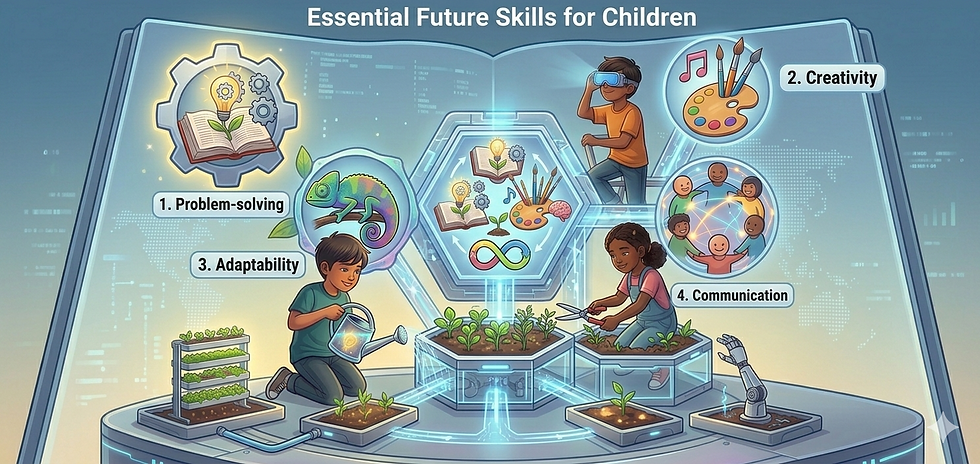
These are future-ready skills for kids competencies that don't expire.
AI Evolution: The Reality Parents Must Face
The AI conversation often focuses on fear: "Will robots take my child's job?" This misses the point entirely.
India Steps onto the Global AI Stage
The scale of AI's momentum became impossible to ignore when New Delhi hosted the India AI Impact Summit 2026 in February 2026 the fourth in a prestigious global series of AI summits following those held at Bletchley Park, Seoul, and Paris, and the first ever to be held in a Global South nation.
The summit, inaugurated by Prime Minister Narendra Modi at Bharat Mandapam, drew delegations from over 100 countries, more than 20 heads of state, and the CEOs of the world's most powerful AI companies including Sam Altman of OpenAI, Sundar Pichai of Google, Dario Amodei of Anthropic, and Demis Hassabis of Google DeepMind.
India's two largest conglomerates, Reliance and Adani, pledged a combined $210 billion in domestic AI and data infrastructure investment. Over 88 countries signed the New Delhi AI Declaration, committing to inclusive AI development with "welfare for all" as its guiding principle.
The message was unmistakable: AI is no longer a Western story. India is writing its own chapter. And it is writing it fast.
For every parent watching this unfold, the question is not whether AI will reshape your child's future it's whether your child will be equipped to shape AI's future in return.
The Real AI Impact
In the next decade, workforce success will not be defined by a single credential the way a degree was in the 1990s. It will be defined by the ability to integrate across disciplines and work fluidly alongside AI systems.
Your child won't compete against AI. They'll work with AI. The question is: will they use AI as a tool that amplifies their capabilities, or will they be replaced by someone who does?
AI-Proof Skills for Kids
Human-centric qualities curiosity, tenacity, experimentation, entrepreneurism, continuous learning, and leadership will remain essential even as technical requirements evolve rapidly.
Think about it:
AI can analyse data → Humans decide what questions to ask
AI can generate reports → Humans define what problems to solve
AI can create content → Humans provide context, creativity, and ethical judgment
AI can optimise processes → Humans envision entirely new possibilities
Preparing kids for future jobs in an AI world means developing the uniquely human capabilities that complement machine intelligence not racing to compete with it.
The Indian AI Opportunity
Anthropic CEO Dario Amodei stated at the India AI Impact Summit that advanced AI could contribute to 25% annual GDP growth for India more than double the expected rate for developed economies. India is positioning itself as a global AI hub, with national programmes in AI infrastructure, skilling, and research already underway.

Your child can be part of this transformation but only if they develop both technological literacy and the human skills that give AI its purpose and direction.
Future-Ready Skills for Kids: The Essential 8
Based on the World Economic Forum's research and India's evolving job market, here are the eight essential skills that will remain valuable across any career path:
1. Analytical Thinking & Problem-Solving
What It Is: Breaking complex problems into components, identifying patterns, evaluating solutions logically.
Why It Matters: Analytical thinking remains the most sought-after core skill, with 7 out of 10 companies considering it essential.
How It Develops Through Experiential Learning:
Hands-on projects with no single "right answer" in the back of a textbook
Real-world challenges requiring students to hypothesise, test, and evaluate outcomes
Troubleshooting multi-layered problems spanning engineering, logic, and design
Iterative design challenges that teach systematic problem isolation over guesswork
2. Creative Thinking & Innovation
What It Is: Generating original ideas, combining concepts in novel ways, seeing possibilities others miss.
Why It Matters: Creative thinking is rising sharply in importance as AI handles routine tasks, leaving innovation as the primary human contribution.
How It Develops Through Experiential Learning:
Open-ended projects where no prescribed solution exists
Design challenges with real constraints forcing creative resourcefulness
Building products and systems from scratch rather than following a fixed recipe
Moving beyond replication into genuine invention

3. Resilience, Flexibility & Agility
What It Is: Adapting to change, recovering from setbacks, pivoting strategies when circumstances shift.
Why It Matters: Modern careers demand constant adaptation. A child conditioned only by structured, predictable exam environments will struggle when the real world demands something entirely different.
How It Develops Through Experiential Learning:
Projects that fail initially and require multiple iterations before they work
Treating setbacks as data points, not personal failures
Adapting mid-project when requirements change or better approaches emerge
Learning to push through the discomfort of not knowing
4. Curiosity & Lifelong Learning
What It Is: Asking "why" and "what if," seeking knowledge independently, and genuinely enjoying the process of discovery.
Why It Matters: The pace of change demands continuous skill acquisition throughout life. A child who learns only when assigned to will fall behind one who learns because they can't help themselves.
How It Develops Through Experiential Learning:
Questions that emerge naturally from doing, not from worksheets
Exploring beyond project requirements out of genuine interest
Self-directed investigation to solve problems encountered along the way
Teaching peers — which deepens and extends understanding further
5. AI Literacy & Technological Fluency
What It Is: Understanding how AI systems work, collaborating effectively with AI tools, and knowing when and how to apply technology responsibly.
Why It Matters: AI and big data top the list of fastest-growing skills across nearly all sectors globally and as the India AI Impact Summit 2026 demonstrated, India is positioning itself at the centre of this shift.
How It Develops Through Experiential Learning:
Training actual machine learning models and understanding their real-world limitations
Using AI as a functional tool within larger creative projects
Knowing when AI is appropriate versus when human judgment is irreplaceable
Exploring the ethics, bias, and responsibility that come with AI use — through experience, not lectures

6. Communication & Collaboration
What It Is: Articulating complex ideas clearly, working effectively in teams, and giving and receiving feedback constructively.
Why It Matters: Even highly technical careers require explaining work to non-technical stakeholders, coordinating across diverse teams, and presenting ideas persuasively. A mark on an exam demonstrates none of this.
How It Develops Through Experiential Learning:
Team projects requiring real coordination and genuine conflict resolution
Presenting technical work to non-technical audiences — parents, judges, community members
Peer feedback sessions that develop both giving and receiving critique
Documentation clear enough for others to independently understand and build upon
7. Leadership & Social Influence
What It Is: Motivating others toward shared goals, making decisions confidently, coordinating efforts, and inspiring action.
Why It Matters: Leadership and social influence have seen a 22 percentage-point rise in importance compared to just a few years ago. Tomorrow's workplaces need people who can lead — not just follow instructions.
How It Develops Through Experiential Learning:
Leading project teams and coordinating people with different strengths
Making design decisions and defending them with reasoned evidence
Mentoring younger or less experienced peers
Taking ownership of outcomes — not just executing someone else's plan
8. Environmental Stewardship & Sustainability Thinking
What It Is: Understanding environmental impact, designing sustainable solutions, and thinking systemically about resources.
Why It Matters: Environmental stewardship ranks among the top 10 skills on the rise globally as climate challenges reshape entire industries. The India AI Impact Summit 2026 itself was structured around three pillars — People, Planet, and Progress — placing sustainability at the heart of AI's future purpose.

Projects that tackle real environmental challenges, not hypothetical textbook scenarios
Designing with resource constraints and long-term efficiency in mind
Understanding trade-offs between performance and sustainability
Measuring and minimising environmental impact as part of the design process itself
Skill Identity Shift: From User to Creator
Here is the truth most parents haven't been told: the biggest barrier to your child's future isn't a missing subject on their timetable. It's a missing identity.
Open any child's phone today. You'll find AI chatbots doing their homework, generating their essays, solving their maths problems, and answering every doubt before they've even tried to think it through.
On the surface, it looks like smart, efficient learning. In reality, it's something far more concerning — it's the quiet habit of always being on the receiving end.
For most of their school lives, children are positioned as users — of knowledge, of systems, of tools others have built. They receive information. They reproduce it.

They are evaluated on how accurately they can recall what someone else created. And now, with AI at their fingertips, even that effort is being outsourced.
AI has fundamentally changed what "being a learner" means — and most children don't realise they're on the wrong side of that change.
At the India AI Impact Summit 2026, world leaders and AI CEOs converged on a shared truth: AI is now capable of performing most knowledge-recall tasks faster, more accurately, and at greater scale than any human.
The child who has spent years optimising for exam performance — absorbing and reproducing information — is now competing directly with a machine that does the same thing, without fatigue, without cost, and without needing twelve years of schooling first.
The child who wins is the one who does what AI cannot: create, question, lead, and build.
The Shift Nobody Is Talking About
Think about how your child interacts with games. They spend hours playing — navigating worlds, solving challenges, mastering mechanics someone else designed. It's engaging. It's even cognitively stimulating. But at the end of every session, they are still just a player in someone else's universe.
Now imagine a different version of that same child — one who looks at a game and asks: "How was this made? What if I designed the levels? What if I created the characters, wrote the story, built the rules?"
That child isn't just playing anymore. That child is thinking like an engineer, a designer, a storyteller, and a problem-solver — all at once.
The same shift applies to every tool they use daily. A child who uses AI to write their essay is a user. A child who uses AI as a creative partner — to brainstorm ideas, challenge their own thinking, test their arguments — is a creator. A child who asks AI to solve their maths doubt learns nothing.
A child who tries the problem first, fails, then uses AI to understand where their thinking broke down — that child is building something that lasts.
The tool is the same. The identity is completely different.
The Three Stages of the Shift
This transformation doesn't happen overnight. It moves through three recognisable stages:
Stage 1 — Consumer: The child waits to be taught. They use AI to get answers, follow instructions, complete assignments, and measure success by marks received. They ask: "What's the right answer?"
Stage 2 — Contributor: The child begins applying knowledge actively. They use AI to explore, not just to answer. They participate in projects, offer original ideas, and start seeing themselves as part of the outcome — not just a recipient of it.
Stage 3 — Creator: The child takes full ownership. They design solutions, define problems, take initiative, and build things that didn't exist before. They use AI as a tool they direct — not one that directs them. They ask: "What could I build? What problem could I solve? What could I make that the world doesn't have yet?"

The goal of future-ready education is to move every child from Stage 1 to Stage 3 and to do it before the world decides that Stage 1 is no longer worth paying for.
How to Raise a Creator, Not Just a User
The shift doesn't require scrapping everything. It requires a change in how your child approaches the tools and learning they already have:
Encourage making over consuming. If your child loves games, encourage them to design one — even a simple board game, a paper prototype, or a basic digital project. If they love music, let them compose rather than just stream. If they love AI, let them build with it rather than just ask it questions.
Reframe the role of AI at home. AI should be a thinking partner, not an answer machine. A simple rule: try it yourself first, then use AI to check, challenge, or extend your thinking — not replace it.
Value the process, not just the product. A child who struggles through a problem and gets it partially right has learned infinitely more than one who copied a perfect answer. Celebrate the attempt. Celebrate the iteration.
Give them real problems to solve. Not exam questions real ones. "How could we reduce electricity use at home? How could we make our building safer? How could we help our school library work better?" These questions have no answer keys. That's exactly the point.
By the time a child has practised thinking this way across different subjects, different tools, different challenges they don't just have skills. They have an identity. I am someone who builds things. I am someone who asks questions. I am someone who creates.
That identity is the most future-proof asset a child can carry. This summer, let your child be a creator—not just a user. Explore future-ready skills for kids.
Building a Future Skills Mindset Through Experiential Learning
Skills for kids aren't just abilities — they're mindsets. The way your child thinks about learning, challenges, and their own capabilities matters as much as anything they know.
The Growth Mindset Foundation
Traditional education often creates a fixed mindset: "I'm good at maths" or "I'm not a science person." Experiential learning develops a growth mindset naturally:
Failure becomes data: When a project doesn't work, it's not "I failed" it's "This approach didn't work; let me try another"
Ability is developed: Success comes from iteration and improvement, not from being born talented
Challenge is opportunity: Difficult projects that require learning new skills become exciting, not threatening
The Problem-Solving Mentality
Perhaps the most valuable future-skills mindset is one that transfers far beyond any single domain:
Expect things not to work the first time that's normal, not failure
Systematically isolate where the breakdown is occurring
Test potential solutions methodically rather than guessing randomly
Learn from what works and what doesn't, then keep going
Iterate until it works, no matter how long that takes
This mentality applies everywhere: school projects that aren't coming together, team conflicts needing resolution, personal goals requiring adjustment, and career challenges demanding entirely new approaches.
From Passive Recipient to Active Builder
Traditional education creates consumers of knowledge. Experiential learning creates producers.
Consumers wait to be taught → Builders seek information when needed
Consumers follow instructions → Builders design solutions
Consumers ask "What's the right answer?" → Builders ask "What could work?"
Consumers complete assignments → Builders develop portfolios
This shift — from passive recipient to active builder is the most valuable transformation a child can experience before entering an AI-shaped world.
Preparing Kids for Future Jobs: What Actually Works
Let's address what parents can actually do to help.
What Doesn't Work
❌ Trying to predict specific career paths: "You should become a data scientist" assumes static, predictable markets
❌ Narrow, exam-focused tutoring aimed purely at marks and rankings
❌ Overspecialisation too early — depth without breadth limits adaptability
❌ Rote learning without application — theoretical knowledge a child cannot actually use in the real world
What Does Work
✅ Developing meta-skills: problem-solving, learning agility, and creativity that transfer across all domains
✅ Cross-disciplinary thinking: combining technical exposure with communication, design, and ethical reasoning
✅ Project-based experience: building actual things, not just studying about them
✅ Iterative learning: failing productively, adjusting, improving — the real learning cycle
✅ Portfolio building: demonstrable capabilities that prove what a child can do, not just what they scored
Conclusion
The future is uncertain. Jobs will change. Technology will evolve. Entire industries will transform.
But here's what we know for certain:
170 million new jobs will be created by 2030. 39% of current skills will be transformed or obsolete. AI, creative thinking, resilience, and curiosity will only grow in importance.
India's moment could not be clearer. As the world's first Global South nation to host a major international AI summit — one that drew 100+ countries, $200 billion in investment pledges, and commitments to AI development that serves all of humanity — India has declared itself a future-shaper, not a bystander.
Your child's advantage won't come from memorising specific facts or scoring well on a particular exam. It will come from:
✓ Thinking analytically to solve problems no one has defined yet
✓ Creating innovatively in ways AI cannot replicate
✓ Adapting flexibly as circumstances constantly change
✓ Learning continuously as new skills become necessary
✓ Leading confidently when opportunities arise
✓ Carrying the identity of a creator — not a consumer
These future-ready skills for kids are not built through lectures and rote revision. They're developed through experiential learning — through building, creating, failing, iterating, and succeeding.
Your child doesn't need to predict their career at age 12. They need to develop the foundational capabilities that make them genuinely valuable — regardless of which career path eventually emerges.
Programmes like Rancho Labs, built on experiential learning principles and founded by IIT Delhi alumni, demonstrate that when students actively create, experiment, and innovate — they don't just prepare for the future. They become the people who build it.
The question isn't whether your child will face an uncertain future. The question is: will they face it as a creator or a consumer?
That future begins now.
Key Takeaways:
FAQs


Comments