

Drone Summer Camp 2026: Your Child Will Build a Drone, Fly It, and Race It — In Just 6 Days
- 20 hours ago
- 15 min read
Close your eyes for a second.
It is Day 6. Your child is standing in a room full of other builders. In their hands is something they made — not bought, not assembled from a kit someone else designed, but actually made. Frame designed in 3D software. Circuit wired by their own hands. Code written by them. Motor calibrated. Battery connected.
The countdown starts.
Three. Two. One.
It lifts.
Not someone else's drone. Theirs. Off the ground, in the air, doing exactly what they programmed it to do.
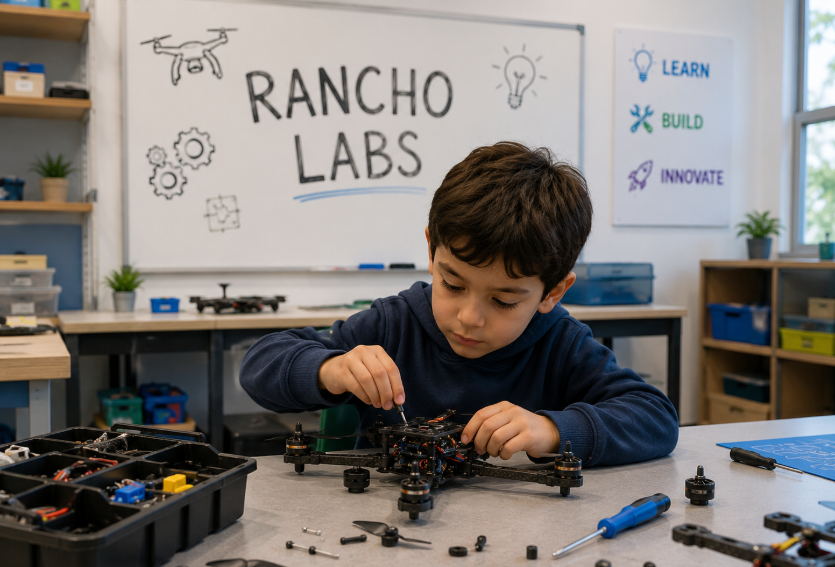
Now open your eyes. That moment is 6 days away. And it is available to your child this summer.
Table of Contents
Why Drones Are the Most Powerful Learning Tool of 2026
What Most "Drone Camps" Are Actually Teaching (Spoiler: Not Much)
The Rancho Labs Difference — Before We Even Get to the Drone
Day 1: Your Child Walks In Not Knowing What a Circuit Is
Day 2: They Write Their First Real Code
Day 3: They Design a Part in 3D Software
Day 4: The Frame Takes Shape
Day 5: Full Assembly — Every Wire, Every Motor, Every Connection
Day 6: First Flight. Then a Race.
What Your Child Actually Learns (It Is Much More Than Drones)
The IIT Delhi Edge: Why This Is Not Just Another Camp
Live Online and Offline: Both Available, Same Standard
The AI Brainwave Membership
Who Should Enroll — And Who This Is Built For
What Your Child Walks Away With
Conclusion: The Moment the Drone Lifts Is the Moment Everything Changes
FAQs
Why Drones Are the Most Powerful Learning Tool of 2026
Here is something worth understanding before anything else: drones are not the point.
The drone is the output. What produces the drone — the thinking, the designing, the wiring, the coding, the debugging, the iterating — that is the point. And the reason drones are such a powerful learning vehicle is because every single one of those skills is immediately, visibly, physically tested the moment the drone either lifts or does not.
There is no hiding in drone building. You cannot fake understanding aerodynamics and have the drone fly. You cannot pretend to know how circuits work and have the motor run. You cannot copy someone else's code and understand why the drone responds the way it does when you tilt the controller. Every gap in understanding shows up immediately, physically, undeniably.
This is why drones teach better than almost anything else:
⚡ Instant feedback — the drone either works or it does not. No partial credit. No "close enough." The feedback loop is immediate and unambiguous.
🔧 Cross-domain learning — in one project, students touch physics, electronics, 3D design, programming, and aerodynamics. Not as separate subjects — as one interconnected challenge.
🧠 Problem-solving under real constraints — weight, balance, motor speed, frame design, battery life — every decision has a consequence that shows up in flight.
🏆 A tangible, demonstrable outcome — at the end, there is something that flies. Something real. Something they can show anyone.
The World Economic Forum consistently lists systems thinking, complex problem solving, and technology literacy as the top skills for the next decade. Drone building develops all three — simultaneously, in six days.
What Most "Drone Camps" Are Actually Teaching (Spoiler: Not Much)
Before you enroll your child anywhere, you deserve an honest picture of what most drone programmes actually deliver — because the marketing and the reality are often very different things.
Category 1: Pre-assembled kit camps Your child receives a drone kit. The drone is already designed. The frame is pre-cut. The wiring diagram is step-by-step. The app connects automatically. They follow the instructions, it flies. They go home. What did they learn? How to follow instructions. Not how drones work. Not how to design one. Not what to do when something goes wrong.
Category 2: FPV flying camps Your child learns to fly a drone — with an FPV headset, through obstacle courses. The flying is genuinely fun. But the drone was built by someone else. The circuit was designed by someone else. The code was written by someone else. They learned to operate a product. Not to build one.
Category 3: Drone awareness sessions One-day or two-day events where someone shows children how drones work, demonstrates a few flights, maybe lets them hold the controller. Educational in the way that watching a cooking show is educational. You understand more than you did before. You cannot cook.
What is missing from all of these:
❌ No 3D design — the child never creates a component
❌ No circuit understanding — they never know why the motor runs
❌ No real programming — they never write code that controls hardware
❌ No aerodynamics — they never understand why their design choices affect flight
❌ No debugging — they never encounter a problem they have to diagnose and fix themselves
When something goes wrong with a drone they assembled from a pre-made kit, they have no idea why. When something goes wrong with a drone they built from scratch — they know exactly where to look.
That is the difference the Rancho Labs Drone Summer Camp is built around.
The Rancho Labs Difference — Before We Even Get to the Drone
Grade 6–12 | Live Online and Offline | 6 Days Intensive
Rancho Labs was founded by IIT Delhi graduates and is incubated by IHFC — the Innovation Hub of IIT Delhi. Trusted by 50,000+ families across India.
But before we get into what makes the drone camp different, one thing needs to be said clearly:
The Drone Summer Camp is the most exciting build of the Rancho Labs summer. It is also the most demanding. By Day 6, every student has gone from zero to flying something they built with their own hands — because every session between Day 1 and Day 5 built the knowledge that makes Day 6 possible.
This is not a camp where the drone is a prop. It is a camp where the drone is the proof — proof of everything the student learned across five days of circuits, code, 3D design, physics, and assembly.
The learning follows the Learn → Build → Innovate framework. Every concept is introduced inside a real project context. Every concept is applied immediately. And every challenge pushes past what was just learned into something the student has not solved before.
No pre-recorded sessions. No passive walkthroughs. Every session is live — a real Rancho Labs industry expert, in real time, guiding students through every stage of the build.
📅 Day 1: Your Child Walks In Not Knowing What a Circuit Is
And walks out having built one.
Day 1 is not an orientation. It is not a welcome session. It is a build session — because the best way to learn about circuits is to build one, not hear about one.
What happens on Day 1:
Students are introduced to the foundational physics of flight — not through a textbook, but through hands-on paper plane design. They explore how wing shape, weight distribution, and aerodynamic forces interact. Why does a heavier nose affect lift? What happens when you increase the angle of attack? These questions get answered through building and testing — not reading.
Alongside this:
Introduction to circuits — what electricity is, how it flows, why it needs a complete path
Basic components — resistors, LEDs, motors, batteries — what each does and why each exists
First hands-on circuit build — a simple circuit that demonstrates current flow and component function
Introduction to the drone frame concept — what a drone needs structurally and why
By the end of Day 1, your child:
✅ Understands what a circuit is — from having built one
✅ Can explain why a drone needs four motors rather than two or three
✅ Has flown a paper plane designed by their own aerodynamic reasoning
✅ Is no longer intimidated by electronics — because they have touched them and made something work
📅 Day 2: They Write Their First Real Code
Not Scratch. Not blocks. Real code.
Day 2 introduces programming — and not the simplified, drag-and-drop version used in most children's coding camps. Real code. The kind that runs on microcontrollers and tells hardware what to do.
What happens on Day 2:
Students are introduced to the programming concepts behind drone control — how code translates into motor speed, how variables store flight parameters, how loops keep the drone stable, how conditionals handle sensor inputs. These concepts are not introduced in a lecture. They are introduced because the drone needs them.
Introduction to microcontrollers — what they are, how they receive and execute instructions
First coding session — writing real code that controls a motor
Understanding the relationship between code and physical behaviour
Sensor fundamentals — how the drone knows where it is and how fast it is moving
Introduction to the flight controller — the brain of the drone and how to communicate with it
By the end of Day 2, your child:
✅ Has written real code that controls real hardware
✅ Understands how a flight controller receives and processes instructions
✅ Can explain what a sensor does and why drones need multiple sensors
✅ Is no longer watching the drone be coded — they are coding it
📅 Day 3: They Design a Part in 3D Software
The same category of software used by engineers at Boeing, Tesla, and Airbus.
Day 3 is the day that tends to surprise parents the most — because a child who had never opened a CAD tool on Day 2 is, by the end of Day 3, designing a drone component in 3D software and preparing it for printing.
What happens on Day 3:
Students are introduced to 3D design software — the same category of tools used by professional engineers across aerospace, automotive, consumer electronics, and robotics. They learn how to create a component from scratch: starting from a concept, building it in three dimensions, checking it against the drone's structural requirements, and preparing the file.
Introduction to 3D design thinking — how engineers translate physical requirements into digital geometry
Hands-on session with CAD software — creating a first 3D component
Drone frame design — understanding what structural requirements the frame must meet
Preparing the design for 3D printing — file format, tolerances, print orientation
Review session — does the design actually work? What needs to change?
By the end of Day 3, your child:
✅ Has designed a 3D component in professional CAD software
✅ Understands how structural requirements translate into design decisions
✅ Has a file ready for printing — a real, physical component of their drone
✅ Can look at any drone and understand why its frame is shaped the way it is
📅 Day 4: The Frame Takes Shape
Where the physical and the digital meet.
Day 4 is when the drone starts to become real — not just on a screen, but in the student's hands. The 3D-printed frame arrives. The components are laid out. The build begins.
What happens on Day 4:
Students receive their 3D-printed drone frame — the component they designed on Day 3 — and begin the assembly process. This is where the knowledge from Days 1, 2, and 3 starts converging. The circuit understanding from Day 1 tells them how to wire the motors. The coding knowledge from Day 2 tells them how to connect the flight controller. The 3D design understanding from Day 3 tells them why each part of the frame is shaped the way it is.
Frame assembly — attaching motors, mounting the flight controller, securing components
Wiring session — connecting every motor to the ESCs and the flight controller
Circuit checking — verifying every connection before any power is applied
Introduction to propellers — the aerodynamics of propeller design and why direction matters
First power-on — checking that all systems respond correctly before flight
By the end of Day 4, your child:
✅ Has a partially assembled drone in front of them — frame, motors, ESCs, flight controller connected
✅ Understands every wiring decision they made and why
✅ Has successfully powered on the system and verified motor response
✅ Is one day away from completing the build
📅 Day 5: Full Assembly — Every Wire, Every Motor, Every Connection
The day everything comes together.
Day 5 is the most intense day of camp — and the most satisfying. Every skill built across four days is deployed simultaneously as students complete their drone.
What happens on Day 5:
Final assembly — propellers mounted, battery connected, everything secured
Pre-flight calibration — configuring the flight controller, calibrating the compass and accelerometer
Safety briefing — understanding drone safety, flight zones, emergency procedures
Bench testing — every system checked and verified before the drone leaves the ground
Software configuration — setting flight modes, response curves, and failsafes through real software
Final systems check — the equivalent of a pre-flight checklist on a real aircraft
By the end of Day 5, your child:
✅ Has a complete, flight-ready drone — built by them, from scratch
✅ Has calibrated every system and verified every connection
✅ Understands the safety protocols of real drone operation
✅ Is ready for Day 6
📅 Day 6: First Flight. Then a Race.
This is the day.
There is nothing else quite like the moment a drone built by a child lifts off for the first time. Not because of what it represents — though it represents a great deal. But because of what it proves. It proves that the circuit is right. The code is right. The assembly is right. The calibration is right. The design is right. Everything they learned, applied, and built across five days is right — and the only way to know that for certain is to watch it fly.
What happens on Day 6:
Final pre-flight checks — student-led, using the checklist they developed
First flight — every student flies the drone they built
Flight practice — basic manoeuvres, stability testing, directional control
Drone Racing Event — a skill-based racing event where every student competes with the drone they built
Innovation Showcase — every student presents their build: what they made, what they learned, what they would design differently
Doubt clearing and Q&A — any remaining questions addressed directly with the mentor
The racing event is not just fun. It is a genuine engineering challenge — because in a race, the drone's performance reflects every design decision made across five days. Weight distribution. Motor selection. Propeller size. Frame geometry. Every choice matters. Every choice was made by the student. The race is the final test of everything they built.
By the end of Day 6, your child:
✅ Has flown a drone they built
✅ Has competed in a drone racing event
✅ Has presented their work to peers and mentors
✅ Understands drone building at a level that almost no child their age has
What Your Child Actually Learns (It Is Much More Than Drones)
The drone is the visible output. Here is what the six days actually develop — skills that transfer far beyond the camp:
What they do in camp | What it actually builds |
Designing the drone frame in 3D | Spatial reasoning, engineering design thinking, understanding of structural constraints |
Wiring the circuit | Electronics literacy, understanding of current, voltage, and component function |
Writing code for the flight controller | Programming logic, hardware-software interaction, debugging methodology |
Calibrating sensors | Understanding of sensor physics, data processing, system integration |
Diagnosing what goes wrong | Systematic problem-solving, hypothesis testing, logical elimination |
Racing and presenting | Communication of technical work, confidence under pressure, iterative improvement |
The child who leaves Day 6 is not just a child who built a drone. They are a child who can look at any complex system — a car, a robot, a production line, a software application — and think: I understand how this works. I could figure out how to build something like it.
That is the shift. That is what six days of building produces. And it is one of the most durable things a child can develop.
For more on why this kind of hands-on, project-first learning creates lasting capability — and why it is increasingly the standard that the best programmes in India are being built around: How Experiential Learning Programs for Kids Transform Traditional Education Through Real-World Skills
And if you want to understand the deeper shift this creates in how a child sees themselves in relation to technology: From Passive User to Active Creator: The AI Summer Camp That Teaches Kids to Build — Not Just Use
The IIT Delhi Edge: Why This Is Not Just Another Camp
🏛️ The concepts are real — not simplified for palatability, but genuinely foundational. The aerodynamics, the electronics, the programming — these are the concepts that engineering students encounter, introduced at an age-appropriate level but without the depth being removed.
👨🏫 The mentors are real — every session is run by an industry professional who has built real things. Not a trained facilitator. An engineer who can answer "but why does that work?" from a place of genuine understanding.
📋 The certificate is real — A Rancho Labs achievement certificate that carries institutional weight in competitive academic applications, school competitions, and early-career portfolios.
📐 The standard is real — the non-negotiable outcome of every Rancho Labs programme is that the child builds something that works. Not a simulation. Not a model. Something functional.
Live Online and Offline: Both Available, Same Standard
Online (Live): Every session is live — a real Rancho Labs expert mentor in real time. No pre-recorded video plays at any point. The mentor guides every stage of the build, answers questions as they arise, and adjusts when something is not landing. Materials are prepared and sent in advance.
Offline: Available at Rancho Labs centres — the same IIT Delhi-designed curriculum, the same live expert mentors, now in person in a dedicated lab environment alongside local peers.
Both formats deliver:
✅ The same six-day build sequence
✅ The same AI Brainwave Membership
✅ The same flying drone on Day 6
The choice is geography and preference. The outcome is identical.
The AI Brainwave Membership
Every student who enrolls is automatically part of the AI Brainwave Membership — Rancho Labs' exclusive post-camp learning community.
The drone gets built in six days. The curiosity it creates lasts much longer. The AI Brainwave Membership is what keeps it going.
What it includes:
Priority access to all future Rancho Labs experiences — camps, competitions, events
50+ premium ongoing projects to explore independently, year-round
Invitation-only workshops and events — members are always on the list
A national community of young builders from across India
Scholarship access and Scholar Magazine
5%+ discount on all future Rancho Labs programmes
Who Should Enroll — And Who This Is Built For
✅ This camp is perfect for your child if:
They are in Grade 6 to Grade 12
They have no prior experience in electronics, coding, or 3D design — the camp starts from zero
They are curious about how things work — not just how to use them
They want something to show for their summer — something real, demonstrable, and genuinely impressive
They are drawn to engineering, aviation, robotics, or technology as a future direction
They want a portfolio-ready project for competitive school applications or STEM competitions
You want a summer investment that compounds — through the AI Brainwave Membership and everything it unlocks
✅ Especially recommended for students who:
Are interested in IIT, aerospace engineering, robotics, or computer science as future paths
Are preparing applications for competitive schools, Olympiads, or international programmes
Have completed a basic coding or robotics introduction and are ready for real depth
Are the kind of child who asks "but how does it actually work?" — because this camp answers that question, thoroughly
What Your Child Walks Away With
🚁 A drone they built Not assembled from a kit. Built — frame designed in 3D, circuit wired, code written, calibrated, and flown. The most tangible proof of capability that any summer programme can produce.
🏆 A racing credential Every student competes in the Day 6 drone racing event. Whether they win or not, they flew something they built — and that is the credential that actually matters.
🏛️ An achievement certificate Not a participation ribbon. A verified credential that names the programme, the skills demonstrated, and the institution behind the standard. Carries genuine weight in competitive academic contexts.
🧠 Cross-domain engineering literacy Aerodynamics. Electronics. Programming. 3D design. Systems integration. These are not things they learned about — they are things they applied. That is a completely different kind of knowledge.
🌐 The AI Brainwave Membership 50+ ongoing projects, national community, invitation-only events, scholarship access. The summer investment keeps compounding long after Day 6.
💪 The confidence that only comes from building Ask any parent what they noticed most when their child came home from camp. Almost all of them describe the same thing: something shifted. A different relationship with difficulty. A certainty — not a hope, a certainty — that they can figure things out. That is the thing no certificate captures. And it is the thing that lasts the longest.
Conclusion: The Moment the Drone Lifts Is the Moment Everything Changes
Go back to the moment at the beginning of this blog.
Day 6. The countdown. Three, two, one. It lifts.
That moment — the moment a child watches something fly that they designed, wired, coded, and assembled themselves — is not just exciting. It is genuinely transformative. Because in that moment, something shifts in how the child understands their own capability. The world of engineering, which might have seemed distant and complicated, is suddenly something they can shape. Something they can build. Something they can make go up.
And once that shift happens, it does not reverse.
Six days. One drone. One IIT Delhi certificate. One moment that stays with your child for the rest of their life.
The countdown starts when you enroll.
FAQs
Q: Does my child need any prior experience in electronics, coding, or 3D design?
No — the Drone Summer Camp is designed entirely from zero. Students who have never touched a circuit or written a line of code go through a structured build from Day 1. The camp is designed so that the learning on each day creates exactly the foundation needed for the next.
Q: What grade levels is this camp suitable for?
Grade 6 through Grade 12. The content is structured to be appropriately challenging across this full range — with the open-ended design and engineering challenges in later sessions pushing further for older students.
Q: Does my child actually fly the drone they built?
Yes — on Day 6, every student flies the drone they built across the five previous days. The Day 6 session includes a drone racing event where every student competes with their own build.
Q: What happens if the drone does not work on Day 6?
This is where the camp's approach pays off most clearly. Because students understand every component of their build — the circuit, the code, the calibration — they have the knowledge to diagnose and fix problems rather than waiting for someone else to fix them. Mentor support is available throughout Day 6 for any student who needs it.
Q: Is this available online or only in person?
Both. All sessions are available fully live online with real expert mentors, and offline at Rancho Labs centres. The curriculum, mentor standard, and outcome — including the flying drone on Day 6 — are identical across both formats.
Q: What does my child do with the drone after camp?
It is theirs. The drone your child builds across six days goes home with them. It is not a kit that gets returned or a model that gets displayed in the classroom. It is a working drone that belongs to the student who built it.
Q: What is the AI Brainwave Membership?
An exclusive post-camp learning ecosystem automatically included with every enrolment — 50+ premium ongoing projects, priority access to all future Rancho Labs experiences, invitation-only events, a national community of young builders, scholarship access, and discounts on future programmes.
Rancho Labs — IIT Delhi-Backed | IHFC-Incubated | Trusted by 50,000+ Families Across India Drone Summer Camp | Grade 6–12 | Live Online and Offline | 6 Days | Summer 2026


Comments